
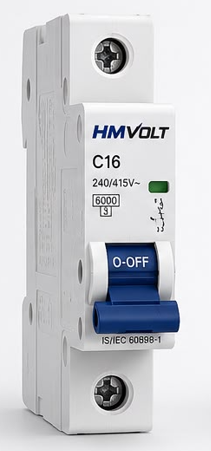
Please refer below Chart :
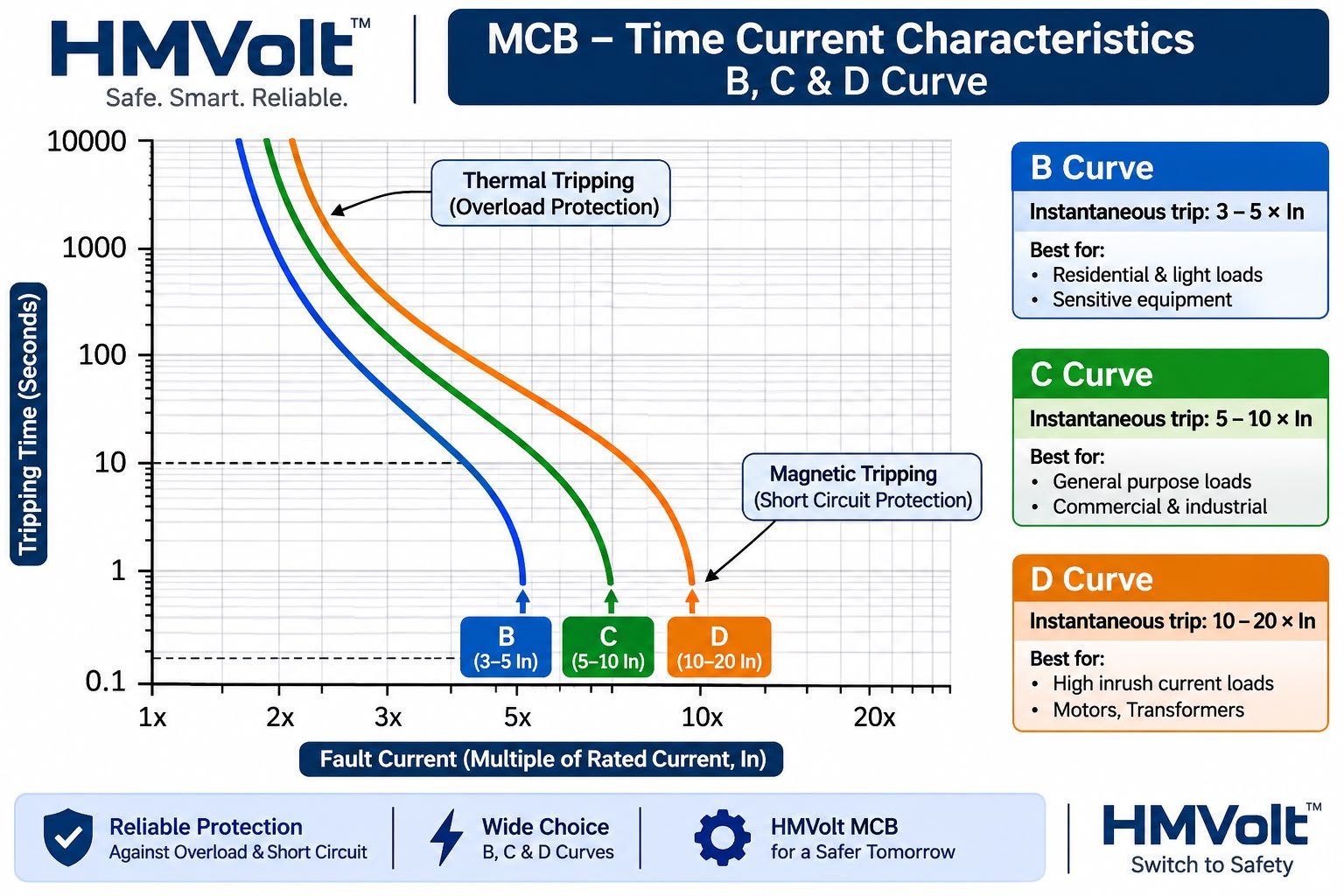
B,C,D, TRIP CURVE for MCB : Trip curve is basically a time and Current Graph or inverse current Graph which define the behavior of MCB in the condition of overload and short Circuit .
As per IEC-60947-2 and IEC 60998-1 ( these are the General standard are for MCB ) There are Basically 2 type of Characteristics for MCBs mentioned below :
1- Thermal Characteristics ( Define by Bimetal Strip )
2- Magnetic Characteristics ( Define by Coil and its resistance )
Thermal Overload protection is same for every Curve : Example : 32A MCB carries 32A continuously and it uses a bimetallic strip (made of two different conductive material ) to trip during slow, sustained overloads (Generally above 1.45 times its rated current) to keep cables from overheating.
Difference in B,C,D Curve Working & Applications
- Please refer the above chart where the difference is mentioned
- Type B : it trips instantly when current increase 3 to 5 times of its rated current In . these MCB used generally for resistive load application such as office & Home load that do not draw a big current spike when it switched on.
- Type C : it trips when current reach at 5 to 10 times of its rated current In. This gap prevents MCB for nuisance tripping when medium inductive load appliances—like Motor, Compressor, ACs or water pumps— at starting of appliance .
- Type D : it holds out until current reaches 10 to 20 times its rated current In. It is built for High inductive load applications such as heavy machinery that generates massive startup surges Ex: welding Machine ,heavy duty motors .
- Selection of MCB : we have to many parameter for selecting a MCB such as fault level ( kA ) , breaking capacity Icu and no. of poles ( 1 phase or 3 phase ).